The Los Angeles Chargers vs Detroit Lions Match Player Stats tell the story of a one-sided 2025 Pro Football Hall of Fame Game. Los Angeles defeated Detroit 34–7 at Tom Benson Hall of Fame Stadium in Canton, Ohio. Although many regular starters did not play, the matchup gave both teams a valuable chance to evaluate backup quarterbacks, young receivers, running backs, defensive players, and special-teams units.
The Chargers controlled the contest from the opening kickoff. They forced five turnovers, protected the football, and scored in every quarter. Meanwhile, Detroit struggled with interceptions, fumbles, and penalties. As a result, Los Angeles consistently started possessions with favorable field position and turned Detroit’s mistakes into points.
Quick Bio Table
| Detail | Information |
|---|---|
| Target keyword | Los Angeles Chargers vs Detroit Lions Match Player Stats |
| Article title | Los Angeles Chargers vs Detroit Lions Match Player Stats and Game Summary |
| Sport | American football |
| League | National Football League |
| Match type | 2025 Pro Football Hall of Fame Game |
| Match date | July 31, 2025 |
| Venue | Tom Benson Hall of Fame Stadium |
| Final score | Chargers 34, Lions 7 |
| Winning team | Los Angeles Chargers |
| Leading passer | Trey Lance — 120 passing yards |
| Leading touchdown scorer | Kimani Vidal — 2 touchdowns |
| Age and height | Not applicable to a match |
| Net worth and family | Not applicable to a match |
Match Overview
The game took place on July 31, 2025, as the traditional opening event of the NFL preseason. Los Angeles entered the night with Trey Lance leading the backup offense, while Detroit used Kyle Allen and Hendon Hooker at quarterback.
The Chargers built a 14–0 lead in the first quarter and entered halftime ahead 21–7. They added six points in the third quarter and seven more in the fourth. Detroit scored only once, completing a long second-quarter drive with a Craig Reynolds rushing touchdown.
| Match detail | Information |
|---|---|
| Teams | Los Angeles Chargers vs Detroit Lions |
| Competition | Pro Football Hall of Fame Game |
| Date | July 31, 2025 |
| Venue | Tom Benson Hall of Fame Stadium |
| Final score | Chargers 34, Lions 7 |
| Halftime score | Chargers 21, Lions 7 |
| Winning team | Los Angeles Chargers |
Quarter-by-Quarter Score
Los Angeles started quickly after recovering a Detroit fumble on the opening kickoff. Trey Lance then connected with tight end Will Dissly for a five-yard touchdown. Shortly afterward, another Lions turnover gave the Chargers a short field, and Kimani Vidal scored on a two-yard run.
Detroit responded in the second quarter when Craig Reynolds finished a long possession with a three-yard touchdown run. However, Lance restored the Chargers’ 14-point advantage before halftime by throwing a 15-yard touchdown pass to KeAndre Lambert-Smith. Cameron Dicker added two field goals in the third quarter, while Vidal scored his second touchdown in the fourth.
| Team | First | Second | Third | Fourth | Final |
| Los Angeles Chargers | 14 | 7 | 6 | 7 | 34 |
| Detroit Lions | 0 | 7 | 0 | 0 | 7 |
Chargers Passing Stats
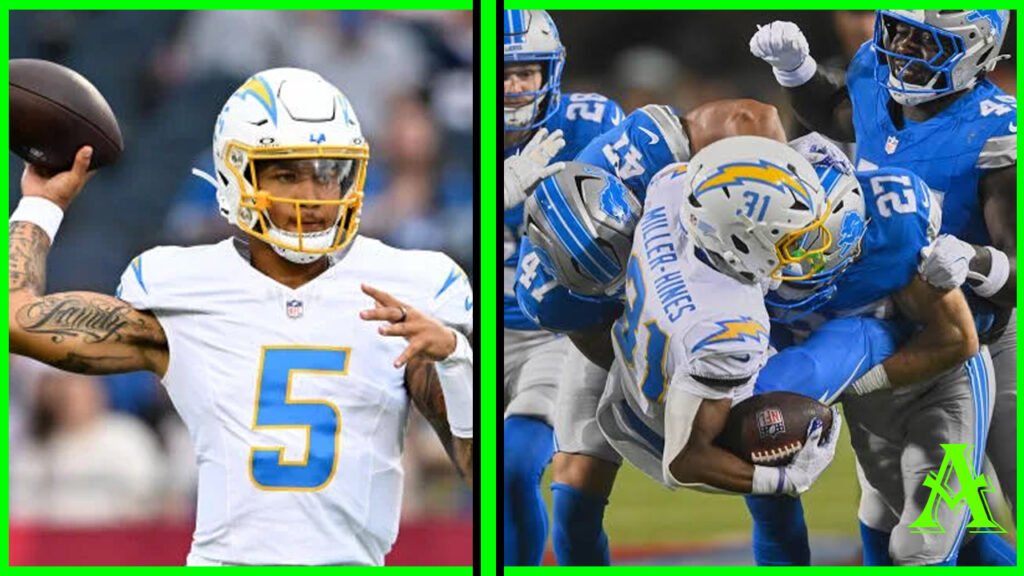
Trey Lance produced the strongest passing performance of the night. He completed 13 of 20 attempts for 120 yards and two touchdowns. More importantly, he did not throw an interception. His calm decision-making helped the Chargers maintain control and take advantage of the opportunities created by their defense.
Lance spread the football around rather than relying on one target. He found Dissly for the opening score and later connected with Lambert-Smith against a Detroit blitz. DJ Uiagalelei entered later and completed two of three passes for 25 yards.
| Player | Completions | Attempts | Yards | Touchdowns | Interceptions |
| Trey Lance | 13 | 20 | 120 | 2 | 0 |
| DJ Uiagalelei | 2 | 3 | 25 | 0 | 0 |
The Los Angeles Chargers vs Detroit Lions Match Player Stats show that quarterback efficiency mattered more than passing volume. Lance did not produce huge yardage, yet he completed important throws, protected the ball, and finished scoring drives.
Chargers Rushing Stats
Kimani Vidal led the Chargers’ rushing attack with 37 yards on nine carries. He also scored two touchdowns, both from two yards out. His performance showed patience, balance, and useful short-yardage power.
Nyheim Hines and Hassan Haskins each added 34 rushing yards. Therefore, Los Angeles did not need to give one running back a heavy workload. The coaching staff rotated several players and used the game to evaluate the depth of the backfield.
| Player | Carries | Yards | Longest run | Touchdowns |
| Kimani Vidal | 9 | 37 | 16 | 2 |
| Nyheim Hines | 8 | 34 | 9 | 0 |
| Hassan Haskins | 6 | 34 | 11 | 0 |
| Omarion Hampton | 2 | 9 | 8 | 0 |
| Trey Lance | 3 | 8 | 5 | 0 |
Vidal’s overall yardage was modest, but his two scores made him one of the most important players in the game. He converted both goal-line opportunities and helped Los Angeles finish drives successfully.
Chargers Receiving Stats
KeAndre Lambert-Smith led the Chargers with 43 receiving yards on two catches. His longest reception gained 28 yards, while his second catch produced a 15-yard touchdown before halftime.
Will Dissly recorded two receptions for 14 yards and caught the opening touchdown. Jaret Patterson added two catches for 18 yards, while Tucker Fisk contributed a 19-yard reception. In total, the Chargers distributed the ball among several receivers, tight ends, and running backs.
| Player | Receptions | Yards | Longest catch | Touchdowns |
| KeAndre Lambert-Smith | 2 | 43 | 28 | 1 |
| Tucker Fisk | 1 | 19 | 19 | 0 |
| Jaret Patterson | 2 | 18 | 12 | 0 |
| Will Dissly | 2 | 14 | 9 | 1 |
| Brenden Rice | 1 | 13 | 13 | 0 |
The Chargers did not depend on one dominant receiver. Instead, Lance used the open option and kept the offense moving. This balanced approach made it harder for Detroit to focus on a single target.
Lions Passing Stats
Detroit’s quarterbacks struggled throughout the game. Kyle Allen completed nine of 14 attempts for 91 yards, but he threw two interceptions. Hendon Hooker completed three of six passes for 18 yards and also threw an interception.
Together, the Lions quarterbacks finished with 109 passing yards, no passing touchdowns, and three interceptions. Those turnovers repeatedly stopped promising possessions and gave Los Angeles excellent field position.
| Player | Completions | Attempts | Yards | Touchdowns | Interceptions |
| Kyle Allen | 9 | 14 | 91 | 0 | 2 |
| Hendon Hooker | 3 | 6 | 18 | 0 | 1 |
The Los Angeles Chargers vs Detroit Lions Match Player Stats highlight the difference between the two quarterback groups. Lance protected the ball and completed two touchdown passes, while Detroit’s quarterbacks combined for three interceptions.
Lions Rushing Stats
Craig Reynolds led Detroit with 38 rushing yards on 10 carries. He also scored the Lions’ only touchdown on a three-yard run in the second quarter. Jabari Small received 11 carries and gained 35 yards, although Detroit struggled to create longer runs.
The Lions showed some patience on their only scoring drive. They used the running game, short passes, and controlled possession before Reynolds reached the end zone. However, once the score widened, Detroit could no longer maintain the same balanced approach.
| Player | Carries | Yards | Longest run | Touchdowns |
| Craig Reynolds | 10 | 38 | 13 | 1 |
| Jabari Small | 11 | 35 | 6 | 0 |
| Hendon Hooker | 3 | 9 | 4 | 0 |
| Jacob Saylors | 2 | 6 | 6 | 0 |
| Kyle Allen | 2 | 5 | 3 | 0 |
Lions Receiving Stats
Isaac TeSlaa led all Detroit receivers with 46 yards on two catches. His size and ability to make plays downfield made him one of the Lions’ few offensive bright spots.
Dominic Lovett recorded a team-high five receptions for 31 yards. Reynolds added one catch for 10 yards, while the rest of Detroit’s receivers produced limited yardage.
| Player | Receptions | Yards | Longest catch | Touchdowns |
| Isaac TeSlaa | 2 | 46 | 24 | 0 |
| Dominic Lovett | 5 | 31 | 10 | 0 |
| Craig Reynolds | 1 | 10 | 10 | 0 |
| Jacob Saylors | 1 | 6 | 6 | 0 |
| Jabari Small | 1 | 6 | 6 | 0 |
Although TeSlaa led the game in receiving yards, Detroit could not turn its passing production into touchdowns. The Lions completed several short throws, but interceptions and penalties prevented them from building consistent momentum.
Team Stats
Los Angeles finished with 261 total net yards, while Detroit recorded 197. The yardage difference was noticeable, but the turnover margin had a much greater effect on the final score.
Detroit committed five turnovers, including three interceptions and two lost fumbles. Los Angeles did not turn the ball over. In addition, the Chargers committed only three penalties for 25 yards, compared with eight penalties for 68 yards by the Lions.
| Team statistic | Chargers | Lions |
| Total net yards | 261 | 197 |
| Turnovers | 0 | 5 |
| Penalties | 3 | 8 |
| Penalty yards | 25 | 68 |
| Time of possession | 32:13 | 27:47 |
| Final points | 34 | 7 |
The Los Angeles Chargers vs Detroit Lions Match Player Stats clearly show how discipline shaped the game. Los Angeles avoided major mistakes, while Detroit repeatedly gave away possession and field position.
Key Performers
Trey Lance was the most influential offensive player. He threw two touchdown passes, completed 65 percent of his attempts, and avoided turnovers. His performance gave the Chargers stability and helped them convert short fields into points.
Kimani Vidal also stood out by scoring twice. Meanwhile, Lambert-Smith led the Chargers in receiving yards and caught an important touchdown. For Detroit, Reynolds produced the only score, while TeSlaa finished as the team’s leading receiver.
On defense and special teams, several Chargers contributed to the five takeaways. Nikko Reed and Tony Jefferson recorded interceptions, while Caleb Murphy helped create the opening turnover. Those plays allowed Los Angeles to take control before Detroit could settle into the contest.
Why the Chargers Won
The Chargers won because they played cleaner and more efficient football. They protected the ball, committed fewer penalties, and took advantage of Detroit’s mistakes. Moreover, their offense performed well in the red zone and converted short-yardage opportunities.
Los Angeles also controlled the pace. The Chargers held possession for more than 32 minutes and forced Detroit to play from behind. As the game continued, their defense kept creating turnovers, while their offense added enough points to remove any realistic chance of a Lions comeback.
What Hurt the Lions
Detroit’s biggest problem was ball security. Five turnovers made it difficult to build momentum or maintain field position. The Lions also committed eight penalties, which added pressure to an offense that already struggled to create explosive plays.
Their quarterbacks showed some accuracy on shorter throws, but the three interceptions overshadowed those completions. Detroit’s running backs produced a few positive gains, yet the growing deficit forced the offense away from a balanced game plan.
Game Summary
The Chargers’ 34–7 victory came through efficient quarterback play, strong short-yardage rushing, and a defense that consistently created takeaways. Los Angeles did not dominate every statistical category, but it controlled the areas that mattered most.
Detroit found brief success during its second-quarter touchdown drive. However, turnovers, penalties, and missed opportunities prevented the Lions from building on that possession. Therefore, the Los Angeles Chargers vs Detroit Lions Match Player Stats reflect a game decided by discipline, field position, and situational execution.
Final Thoughts
The Los Angeles Chargers vs Detroit Lions Match Player Stats and Game Summary show why preseason football involves more than the final score. Coaches use these games to evaluate depth, decision-making, and the ability of younger players to perform under pressure.
Trey Lance, Kimani Vidal, and KeAndre Lambert-Smith gave Los Angeles encouraging performances. Craig Reynolds and Isaac TeSlaa provided Detroit with positive moments, but the Lions’ five turnovers shaped the result.
Frequently Asked Questions
Who won the Los Angeles Chargers vs Detroit Lions game?
The Los Angeles Chargers defeated the Detroit Lions 34–7 in the 2025 Pro Football Hall of Fame Game.
Who was the best player in the match?
Trey Lance delivered one of the strongest performances. He completed 13 of 20 passes for 120 yards, threw two touchdowns, and avoided interceptions.
Who scored the most touchdowns?
Kimani Vidal scored two rushing touchdowns for the Chargers. Will Dissly and KeAndre Lambert-Smith also caught one touchdown pass each.
Who led the game in receiving yards?
Detroit receiver Isaac TeSlaa led the game with 46 receiving yards. KeAndre Lambert-Smith led the Chargers with 43 yards.
What decided the Chargers vs Lions game?
Turnovers made the biggest difference. Detroit committed five turnovers, while Los Angeles protected the football and repeatedly gained favorable field position.
See more amazing Information visit Aurelia News