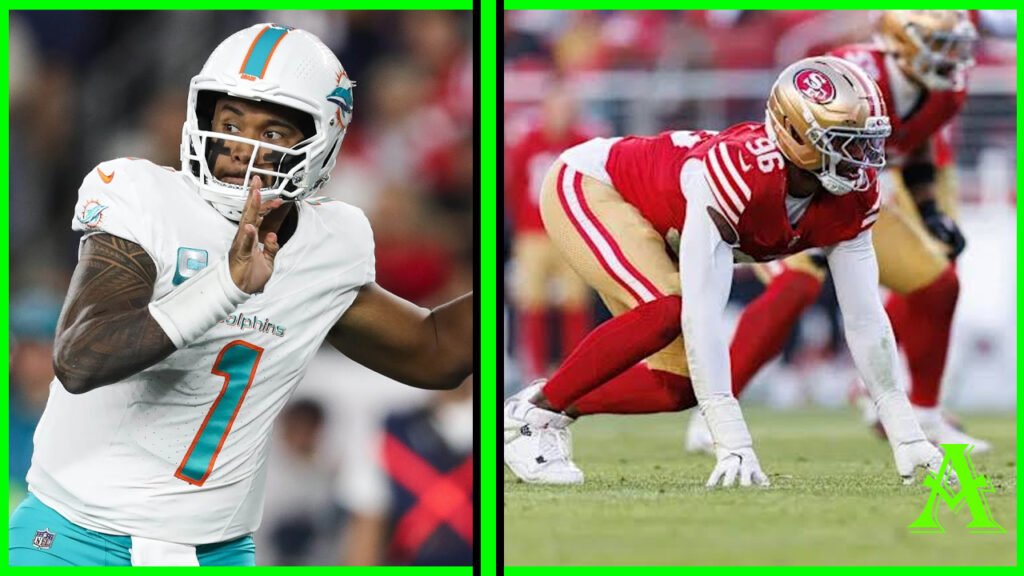
The San Francisco 49ers and Miami Dolphins met at Hard Rock Stadium on December 22, 2024, in a Week 16 game that carried major postseason importance. Miami entered the contest needing a victory to remain in the AFC playoff race, while San Francisco hoped to end a difficult run of results and keep its fading season alive.
Miami earned a 29-17 victory after producing the stronger rushing performance, controlling possession, avoiding turnovers, and receiving an excellent contribution from kicker Jason Sanders. San Francisco moved the ball effectively through the air, but penalties, limited rushing production, a missed field goal, and a late interception prevented the visitors from completing a comeback.
The 49ers vs Miami Dolphins Match Player Stats show that the game remained close until the final minutes. San Francisco trailed by only five points before Kader Kohou intercepted Brock Purdy. De’Von Achane then finished the contest with a 50-yard touchdown run, turning a competitive game into a 12-point Miami win.
Quick Bio Table
| Detail | Information |
|---|---|
| Match | San Francisco 49ers vs Miami Dolphins |
| Competition | NFL regular season |
| Week | Week 16 |
| Date | December 22, 2024 |
| Venue | Hard Rock Stadium |
| Location | Miami Gardens, Florida |
| Final score | Dolphins 29, 49ers 17 |
| Winning team | Miami Dolphins |
| Leading passer | Brock Purdy — 313 yards |
| Leading rusher | De’Von Achane — 120 yards |
| Leading receiver | George Kittle — 106 yards |
| Player of the game | De’Von Achane |
Match overview
Miami opened the scoring with a 44-yard field goal from Jason Sanders in the first quarter. San Francisco responded early in the second quarter when Purdy connected with Deebo Samuel for a 16-yard touchdown. Samuel caught the ball near the middle of the field, fought through several defenders, and powered his way into the end zone.
Sanders added another field goal before Tua Tagovailoa found Tyreek Hill for a three-yard touchdown. Jake Moody made a 21-yard field goal before halftime, leaving Miami with a 13-10 lead.
The Dolphins controlled the third quarter through field position, possession, and two more Sanders field goals. San Francisco finally answered in the fourth quarter when Purdy delivered a two-yard touchdown pass to Eric Saubert. That score reduced Miami’s advantage to 19-17, but the 49ers could not complete the comeback.
Sanders kicked his fifth field goal with 2:10 remaining. Shortly afterward, Kohou intercepted Purdy, and Achane broke free for the game-clinching touchdown.
| Team | First quarter | Second quarter | Third quarter | Fourth quarter | Final |
|---|---|---|---|---|---|
| San Francisco 49ers | 0 | 10 | 0 | 7 | 17 |
| Miami Dolphins | 3 | 10 | 6 | 10 | 29 |
Team statistics
The overall numbers suggest a closely contested game. Miami recorded 381 total net yards, while San Francisco finished with 374. However, the way each team gained those yards played an important role in the result.
San Francisco relied heavily on Purdy and the passing game. The 49ers produced only 81 rushing yards on 18 attempts, while Miami ran for 166 yards on 30 carries. The Dolphins averaged 5.5 yards per rushing attempt and used their ground game to remain balanced.
Miami also controlled the ball for 33 minutes and 6 seconds, compared with San Francisco’s 26 minutes and 54 seconds. That possession advantage allowed the Dolphins to sustain drives and keep San Francisco’s offense on the sideline.
Penalties created another major difference. The 49ers committed 11 penalties for 90 yards, while Miami had six penalties for 45 yards. San Francisco’s mistakes repeatedly damaged field position and made important drives more difficult.
| Category | 49ers | Dolphins |
| Total net yards | 374 | 381 |
| Rushing yards | 81 | 166 |
| Passing net yards | 293 | 215 |
| Penalties | 11 | 6 |
| Penalty yards | 90 | 45 |
| Turnovers | 1 | 0 |
| Time of possession | 26:54 | 33:06 |
Brock Purdy’s performance
Brock Purdy completed 26 of 40 passes for 313 yards, two touchdowns, and one interception. He averaged 7.8 yards per attempt and finished with a passer rating of 95.1.
Purdy’s yardage total was impressive, especially because San Francisco played without a consistent rushing attack. He distributed the ball to seven receivers and completed several important throws in the middle of the field. His touchdown passes went to Deebo Samuel and Eric Saubert.
However, Miami’s defensive front created pressure at important moments. Purdy took three sacks for a loss of 20 yards. Jordyn Brooks, Zach Sieler, and Chop Robinson each recorded a sack for the Dolphins.
The final interception defined the closing minutes. With San Francisco trailing 22-17 and attempting to drive for a winning touchdown, Purdy threw over the middle toward Jauan Jennings. Kohou read the play, stepped into the passing lane, and secured the interception.
Although Purdy produced more passing yards than Tagovailoa, the turnover gave Miami the decisive advantage. The 49ers vs Dolphins player stats therefore show that passing volume alone did not determine the winner.
Tua Tagovailoa’s performance
Tua Tagovailoa completed 22 of 34 passes for 215 yards, one touchdown, and no interceptions. His 64.7 completion percentage and 92.2 passer rating reflected a controlled performance rather than an explosive one.
Tagovailoa did not need to force difficult throws because Miami’s running game remained productive. Instead, he used short and intermediate passes to Achane, Jonnu Smith, Tyreek Hill, and Malik Washington.
His only touchdown pass came late in the second quarter. Tagovailoa found Hill from three yards out to give Miami a 13-7 lead. The score was also the 100th touchdown pass of his NFL career.
Most importantly, Tagovailoa protected the football. San Francisco failed to sack him, and he did not throw an interception. That clean performance helped Miami win the turnover battle and maintain favorable field position.
The quarterback comparison favored Purdy in yards and touchdown passes. Nevertheless, Tagovailoa played the more secure game, received stronger support from his rushing attack, and avoided the late mistake that changed the result.
De’Von Achane leads Miami
De’Von Achane delivered the best individual performance of the game. He rushed 17 times for 120 yards and one touchdown, averaging 7.1 yards per carry. He also caught six passes for 70 yards, giving him 190 yards from scrimmage.
Achane contributed throughout the contest rather than relying only on his late touchdown. His speed created problems for San Francisco’s linebackers, while his receiving ability gave Tagovailoa a reliable option underneath.
His biggest play came after Kohou’s interception. Miami needed only a few plays before Achane found an opening and accelerated through the defense for a 50-yard touchdown. The run extended the lead to 29-17 and removed any realistic chance of a San Francisco comeback.
Raheem Mostert supported Achane with 31 rushing yards on eight attempts. Jeff Wilson Jr. added 12 yards, while fullback Alec Ingold gained four yards on his only carry.
The Miami Dolphins stats clearly show why their rushing attack mattered. Miami nearly doubled San Francisco’s rushing total and produced the longest offensive play of the game on Achane’s final touchdown.
San Francisco’s receiving leaders
George Kittle led the 49ers with eight receptions for 106 yards. He averaged 13.3 yards per catch and recorded a long reception of 28 yards. Kittle did not score, but his ability to find space over the middle helped San Francisco sustain several drives.
Deebo Samuel also delivered one of his strongest performances of the late season. He caught seven passes for 96 yards and one touchdown, while adding 25 rushing yards on five attempts. His 121 total offensive yards made him San Francisco’s most versatile contributor.
Jauan Jennings recorded four receptions for 51 yards, and rookie Ricky Pearsall caught all four of his targets for 37 yards. Kyle Juszczyk added a 20-yard reception, while Saubert’s only catch resulted in a two-yard touchdown.
San Francisco’s leading receivers created enough production to keep the game competitive. However, the offense could not consistently finish drives. The 49ers gained substantial yardage between the 20-yard lines but scored only 17 points.
Miami’s receiving leaders
Achane led Miami with 70 receiving yards, but Jonnu Smith also played an important role. Smith caught all six of his targets for 62 yards, including a 22-yard reception. His performance helped him establish new single-season Miami records for receptions and receiving yards by a tight end.
Tyreek Hill finished with three catches for 29 yards and one touchdown on seven targets. San Francisco’s secondary limited his explosive plays, although his scoring reception gave Miami its first touchdown.
Malik Washington added three catches for 28 yards, while Mostert caught two passes for 15 yards. River Cracraft and Durham Smythe combined for 11 receiving yards.
Miami did not produce a 100-yard receiver. Instead, Tagovailoa spread the ball across several options and allowed Achane to create yards after the catch.
Defensive standouts
Kader Kohou made the most important defensive play when he intercepted Purdy during San Francisco’s final serious possession. The turnover came immediately after the two-minute warning and allowed Miami to protect its five-point advantage.
Miami’s defensive line also influenced the game. Brooks, Sieler, and Robinson combined for three sacks. Robinson added an important pass deflection during a red-zone possession that forced San Francisco to settle for a field goal.
For the 49ers, Fred Warner led the defense with 11 tackles. His performance gave him at least 115 tackles in each of his first seven NFL seasons, placing him among a small group of consistently productive linebackers.
Deommodore Lenoir made an important pass breakup in the end zone during the first quarter. His coverage prevented a possible touchdown to Hill and forced Miami to settle for its opening field goal.
Still, San Francisco’s defense could not create a turnover or record a sack. That lack of disruptive plays made it difficult to slow Miami’s balanced offense.
Jason Sanders makes the difference
Jason Sanders had one of the most influential performances in the complete 49ers vs Dolphins game breakdown. He made all five of his field-goal attempts from 44, 38, 54, 33, and 48 yards.
Those kicks accounted for 15 of Miami’s 29 points. More importantly, Sanders repeatedly rewarded drives that stalled before reaching the end zone. His accuracy allowed Miami to keep building its lead without taking unnecessary fourth-down risks.
Jake Moody made a 21-yard field goal for San Francisco but missed from 41 yards in the third quarter. The miss came after the 49ers reached Miami’s 20-yard line and then lost three yards. At that stage, San Francisco had an opportunity to reduce the deficit, but the empty possession allowed Miami to maintain control.
The difference between the kickers became one of the clearest statistical factors in the game. Sanders remained perfect, while San Francisco left three points on the field.
Why Miami won
Miami won because it played the cleaner and more balanced game. The Dolphins rushed for 166 yards, committed fewer penalties, controlled possession, protected their quarterback, avoided turnovers, and received flawless production from Sanders.
San Francisco had success through Purdy, Kittle, and Samuel. However, the 49ers depended too heavily on the passing game. They also committed 11 penalties, allowed three sacks, missed a field goal, and turned the ball over during the final two minutes.
The final score did not fully reflect how close the contest remained. San Francisco trailed by only two points early in the fourth quarter and by five points after Sanders’ final field goal. Still, Miami made the defining plays when the pressure increased.
Kohou’s interception and Achane’s 50-yard run represented the final turning point. Together, those plays transformed a close finish into a comfortable Dolphins victory.
Final thoughts
The 49ers vs Miami Dolphins Match Player Stats highlight two very different offensive approaches. San Francisco generated more passing yards and had two receivers approach or exceed 100 yards. Miami, meanwhile, relied on balance, ball security, rushing efficiency, and dependable kicking.
Achane deserved recognition as the player of the game after producing 190 yards from scrimmage and the decisive touchdown. Sanders also played a major role by converting five field goals, including two attempts from at least 48 yards.
Frequently Asked Questions
Who won the 49ers vs Miami Dolphins game?
The Miami Dolphins defeated the San Francisco 49ers 29-17 in their Week 16 matchup at Hard Rock Stadium.
Who had the most passing yards?
Brock Purdy led the game with 313 passing yards. He completed 26 of 40 passes and threw two touchdowns with one interception.
Who was the leading rusher?
De’Von Achane led all players with 120 rushing yards on 17 carries. He also scored a 50-yard touchdown late in the fourth quarter.
Who recorded the most receiving yards?
George Kittle led the game with 106 receiving yards on eight catches. Deebo Samuel followed with 96 yards and one touchdown.
Who was the player of the game?
De’Von Achane was the standout performer. He produced 190 yards from scrimmage, including 120 rushing yards, 70 receiving yards, and the game-clinching touchdown.
See more amazing Information visit Aurelia News